
Melbourne old map
You can find on this page the Melbourne old map to print and to download in PDF. The Melbourne historical map and the vintage map of Melbourne present the past and evolutions of the city of Melbourne in Victoria - Australia.
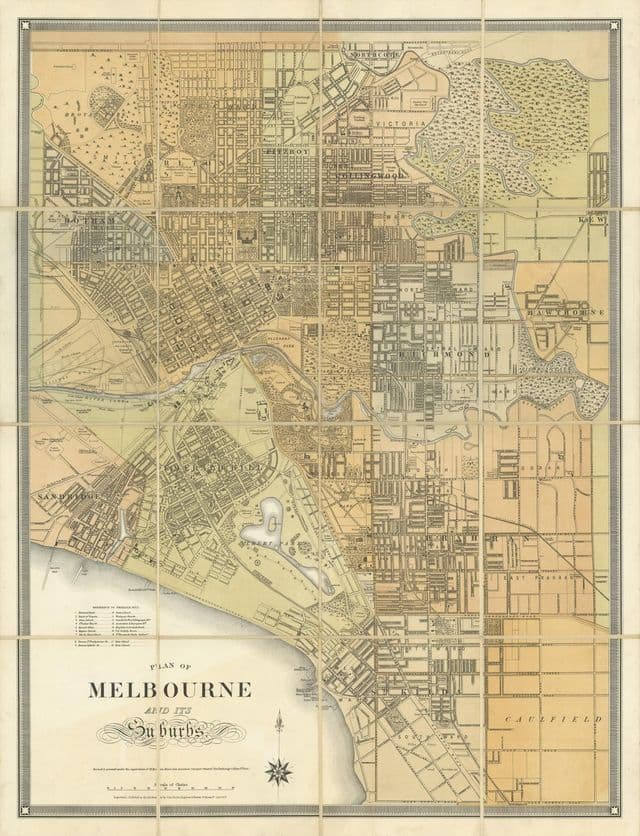
Melbourne historical map
The Melbourne old map shows evolutions of Melbourne city. This historical map of Melbourne will allow you to travel in the past and in the history of Melbourne in Victoria - Australia. The Melbourne ancient map is downloadable in PDF, printable and free.
Port Phillip Bay was discovered by Europeans in 1802, when Lieutenant John Murray and Captain Matthew Flinders visited the bay within a few months of each other. This historical area was then part of the colony of New South Wales, and the colony governor, Philip Gidley King, instructed the surveyor-general, Charles Grimes, to examine the shores of the bay with a view to identifying sites for future settlement (see Melbourne historical map). In 1803 Grimes and his party discovered the Yarra River and traveled along its lower course. Unlike some members of the party, Grimes was not enthusiastic about the Yarra River as a potential settlement. Later in the same year Captain David Collins arrived with a contingent of soldiers and convicts and settled near Sorrento, just inside the entrance to the bay on the east coast. Within a few months, however, he decided that the location was unsuitable and moved his group to Tasmania.
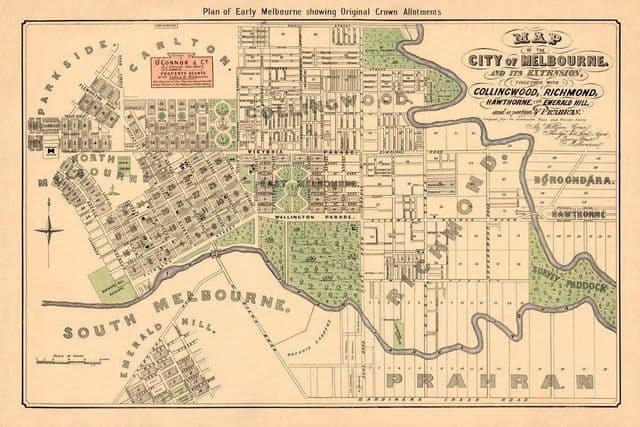
Melbourne vintage map
The Melbourne vintage map give a unique insight into the history and evolution of Melbourne city. This vintage map of Melbourne with its antique style will allow you to travel in the past of Melbourne in Victoria - Australia. The Melbourne vintage map is downloadable in PDF, printable and free.
Melbourne capitalized on its vintage central position within Victoria and its port facilities to capture most of the region trade. Between 1856 and 1873, railways were built to Geelong, Ballarat, Bendigo, Echuca, and Wodonga, and in 1883 a link with the New South Wales rail system was established at Albury as its mentioned in Melbourne vintage map. In 1877 the Melbourne Harbour Trust was created, and the Coode Canal was cut in the soft alluvial sediments of the lower Yarra River to provide a more direct course free from silting problems. During the 1870s manufacturing flourished under the protection of a high tariff, and progress in most spheres continued until 1889, when a financial crisis and the collapse of many firms lowered public confidence.